 Charger Types
Table of Contents
You have settled on a Level 2 home charger. Good call. But now comes the next decision - do you go with a basic charger that simply delivers power, or do you spend more on a smart EV charger loaded with WiFi, app control, and energy tracking?
It is not a small price difference. A basic Level 2 charger runs $200 to $350, while a smart EV charger typically lands between $500 and $800. That gap of a few hundred dollars buys you a stack of features, but the real question is whether those features actually matter for how you charge day to day.
This guide walks through every major difference so you can make a confident decision.
What Makes an EV Charger “Smart”?
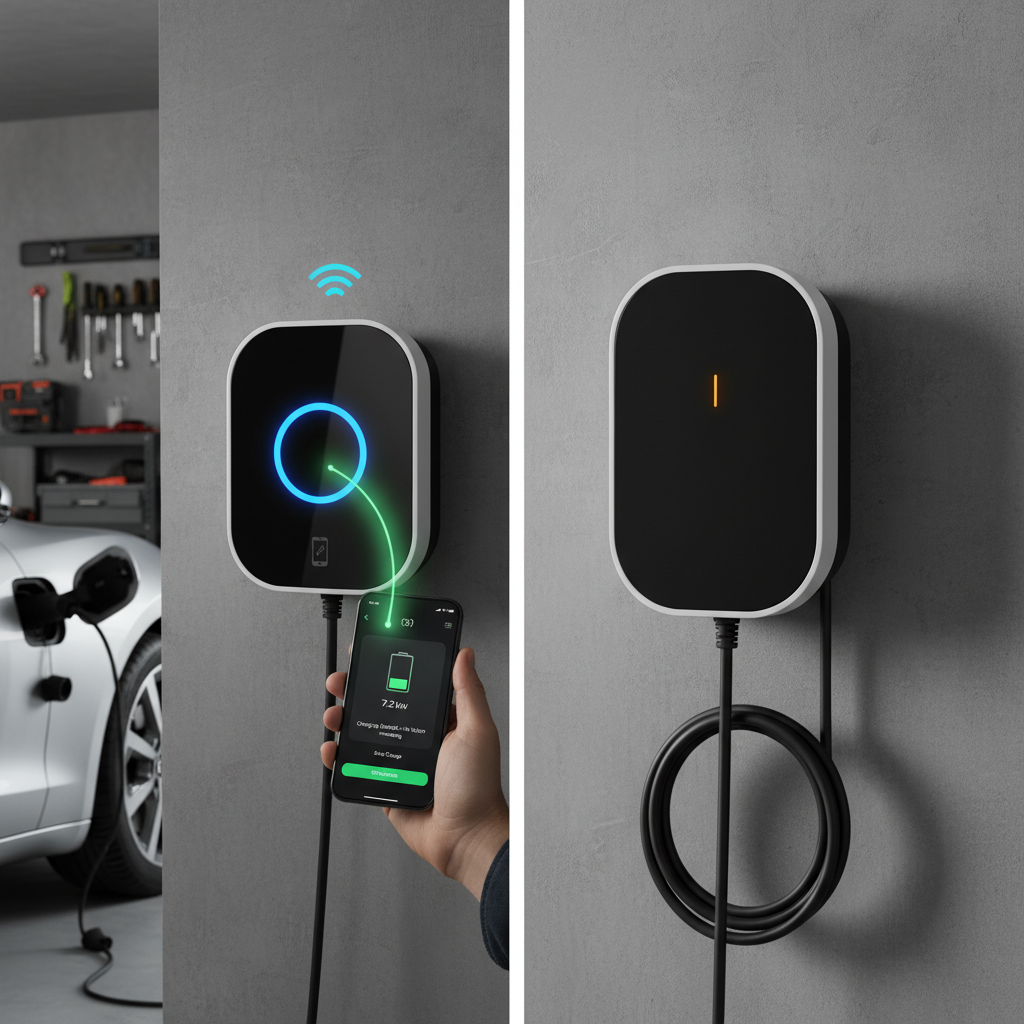
A smart EV charger connects to your home WiFi network and pairs with a smartphone app. That connectivity unlocks a set of features that basic chargers simply cannot offer.
Here is what you get with most smart chargers on the market in 2026:
- Scheduled charging - Set your charger to start and stop at specific times, usually to take advantage of cheaper off-peak electricity rates.
- Energy monitoring - Track exactly how many kilowatt-hours you use per session, per week, or per month. Some apps break this down into estimated cost.
- Load management - The charger communicates with your electrical panel (or other smart devices) to avoid overloading your home’s circuits. This is especially useful in older homes with 100-amp or 150-amp panels.
- App control - Start, stop, or adjust charging from anywhere using your phone. Handy if your schedule changes last minute.
- Utility integration - Some smart chargers connect directly to your electric utility’s programs, automatically shifting charging to the cheapest hours or qualifying you for rebates.
- Over-the-air updates - The charger’s firmware can be updated remotely, meaning new features or bug fixes arrive without you doing anything.
- Usage history and reporting - Useful if you need to track charging costs for tax purposes, fleet management, or reimbursement from an employer.
What Does a Basic Charger Do?
A basic Level 2 charger does one thing well - it delivers 240-volt power to your EV. You plug it in, and it charges. When the car’s battery is full, it stops. That is the entire experience.
Basic chargers are sometimes called “dumb” chargers, though that undersells them. They are reliable, simple, and have fewer components that can fail. Most basic units offer:
- Fixed amperage output - Typically 32 amps or 40 amps, delivering around 20 to 25 miles of range per hour.
- LED status indicators - Simple lights showing whether the charger is connected, charging, or finished.
- Weatherproof housing - Many basic units carry NEMA 4 ratings, making them perfectly suitable for outdoor installation.
- Long cable lengths - 20- to 25-foot cables are standard on most models.
What you will not get is any connectivity, scheduling, or usage tracking. If you want to charge during off-peak hours, you set a timer on the car itself (most modern EVs support this) or simply plug in at the right time.
The Case for a Smart EV Charger
Save Money with Scheduled Charging
This is the single biggest reason people choose a smart EV charger. If your utility offers time-of-use rates - and most do - electricity can cost half as much between 11 PM and 6 AM compared to peak afternoon hours. A smart charger lets you plug in whenever you get home but delay charging until rates drop.
Yes, many EVs have built-in scheduling through the car’s own interface. But charger-level scheduling tends to be more reliable, easier to adjust on the fly through the app, and works consistently across different vehicles if your household has more than one EV.
Track Your Actual Charging Costs
With a basic charger, you are guessing. You know your electricity rate and you can estimate how much energy your car used, but a smart charger gives you precise data. Over 12 months, that visibility helps you understand the true cost of ownership and whether your current rate plan is still the best option.
Some smart charger apps even generate monthly cost reports you can hand to an accountant or use for EV tax credit documentation.
Load Management Prevents Electrical Problems
This feature alone can save you thousands of dollars. If your home has a 100-amp electrical panel - common in houses built before 2000 - running an EV charger at 40 amps alongside your air conditioner, electric dryer, and oven can push your panel past its limit.
A smart EV charger with load management dynamically adjusts its power draw based on what else is running in your home. Instead of tripping breakers or requiring a costly panel upgrade, the charger simply throttles back when demand is high and ramps up when other loads drop off.
Without this feature, many homeowners face a $2,000 to $4,000 electrical panel upgrade just to safely add a Level 2 charger.
Future-Proofing
Utility programs, rebates, and vehicle-to-grid technology are evolving fast. A smart charger with over-the-air updates and utility integration is positioned to take advantage of new programs as they roll out. Some utilities already pay EV owners to let them manage charging during grid emergencies - but only if your charger supports it.
The Case for a Basic Charger
Lower Upfront Cost
A quality basic Level 2 charger like the Lectron V-Box or Grizzl-E Classic costs $250 to $350. A comparable smart charger like the ChargePoint Home Flex or Emporia EV Charger runs $500 to $700. If budget is tight, a basic charger gets you fast Level 2 charging without the premium.
Simplicity and Reliability
Fewer components mean fewer things that can break. A basic charger has no WiFi module, no cloud server dependency, and no app that might glitch after an update. It works the same way on day one as it does on day 1,000. For people who just want to plug in and not think about it, that simplicity has real value.
Your Car Probably Handles Scheduling Already
Most EVs sold in the last five years include charge scheduling through the car’s built-in software or manufacturer app. Tesla, Chevy, Ford, Hyundai, Kia, BMW - they all offer this. If your primary reason for wanting a smart charger is scheduled charging, check your car’s settings first. You might already have what you need.
No Cloud Dependence
Smart chargers rely on the manufacturer’s servers to deliver app features. If that company goes under, gets acquired, or sunsets the product, your smart charger could lose its smart features overnight. A basic charger has no such risk - it will charge your car as long as it has power.
Smart vs. Basic: Side-by-Side Comparison
| Feature | Smart EV Charger | Basic Charger |
|---|---|---|
| Price range | $500–$800 | $200–$350 |
| Charging speed | 25–30 mi/hr (40–48A) | 20–25 mi/hr (32–40A) |
| Scheduled charging | Yes, via app | No (use car’s built-in) |
| Energy monitoring | Yes, detailed reports | No |
| Load management | Yes (select models) | No |
| App control | Yes | No |
| Utility rebate eligible | Often yes | Sometimes |
| WiFi required | Yes | No |
| Cloud dependency | Yes | No |
Who Should Buy a Smart EV Charger?
A smart EV charger makes the most sense if:
- You have time-of-use electricity rates and want precise control over when charging happens.
- Your electrical panel is at or near capacity and you need load management to avoid a panel upgrade.
- You own multiple EVs or plan to add one soon.
- You want detailed cost tracking for tax, business, or budgeting purposes.
- Your utility offers demand response or managed charging incentive programs.
Who Should Stick with a Basic Charger?
A basic charger is the right call if:
- You want the lowest upfront cost and your car handles scheduling on its own.
- You have a newer home with a 200-amp panel and plenty of electrical capacity.
- You prefer simple, reliable hardware with no internet dependency.
- You charge on a flat-rate electricity plan where timing does not affect your bill.
The Bottom Line
For most EV owners in 2026, a smart EV charger is worth the upgrade - especially if you have time-of-use rates or a panel that is close to capacity. The energy savings from scheduled charging alone can recoup the price difference within one to two years, and load management can save you from a panel upgrade that costs ten times more than the charger itself.
But if your situation is straightforward - a newer panel, a flat electricity rate, and a car that schedules charging on its own - a basic charger does the job reliably at a lower price. There is no shame in keeping it simple.
Either way, make sure your charger is installed by a licensed electrician who can assess your panel, run the right circuit, and ensure everything is up to code. The charger is only as good as the installation behind it.
Sponsored
Need Help With Your EV Charger?
Get expert guidance on installation, costs, and the right charger for your home.
Get Your Free EstimateNeed Help With Your EV Charger?
Get expert advice on the right charger, installation requirements, costs, and how to maximize your savings.