 Basics
Table of Contents
It is one of the first ideas almost every new EV owner has: “There is already a big 240-volt outlet behind my stove. Why can’t I just plug my charger into that?” On the surface it makes sense. Your range outlet and a popular EV charging outlet can be the exact same NEMA 14-50 plug. They look identical. The problem is that looking identical and being electrically equivalent are two very different things, and the gap between them is where outlets melt and breakers fail.
If you have been told that an EV-ready outlet is “expensive for what it is,” this is the article that explains where that cost actually goes, and why it is not the same twenty-dollar receptacle your stove is plugged into.
They Look Identical, and That Is the Trap
A NEMA 14-50 is a 240-volt, 50-amp receptacle. Electric ranges have used them for decades, and because Tesla and other automakers popularized the 14-50 for home charging, a lot of people assume a stove outlet is automatically an EV outlet. The plug fits. The voltage matches. So what is the difference?
The difference is not the shape of the plug. It is everything behind the wall: how the circuit was sized, how the breaker is rated, where the outlet sits, and crucially, how long the thing plugged into it runs at full power. Your range and your car use that same outlet in completely different ways, and the electrical code treats them differently for good reason.
The Real Difference: Continuous Load vs. Intermittent Load
When you cook, your oven and burners cycle. They surge to full power, then back off as thermostats hold temperature. Even on a holiday, your range almost never pulls its maximum rated current for hours without a break. Electricians call that an intermittent load, and the connections in the circuit get plenty of chances to cool down between surges.
An EV charger does the opposite. When you plug in at night, it draws near its maximum rated current for six, eight, sometimes ten hours straight. That is the textbook definition of a continuous load: any load that runs at its maximum for three hours or more. And continuous load is exactly where heat becomes the enemy. Every connection in an electrical system generates a little heat from resistance. With intermittent use that heat dissipates. With continuous use it accumulates faster than it can escape.
Why the 80 Percent Rule Changes the Math
The National Electrical Code accounts for this with the continuous-load rule, often shorthanded as the 80 percent rule. For a continuous load, you are only allowed to use 80 percent of a circuit’s rated capacity. On a 50-amp NEMA 14-50 circuit, that means 40 amps maximum for EV charging, not 50.
This is why a charger hardwired or set up for a 50-amp circuit is configured to pull 40 amps. Your stove is not bound by that derating in the same way, so a circuit that is perfectly legal and safe for a range may be undersized the moment you ask it to charge a car for eight hours. Same outlet, same plug, very different rules.
Why Your Existing Stove Outlet Usually Will Not Cut It
Beyond the load math, there are three practical reasons the outlet behind your range is rarely a drop-in EV solution.
First, an EV charging circuit must be dedicated. It serves the charger and nothing else. Your stove outlet is, by definition, serving your stove. You cannot legally or safely run a car charger off a shared circuit. Second, location. Your range outlet is in the kitchen. Your car is in the garage or the driveway, often on the other side of the house, which means a new circuit run regardless. Third, and most important for 2026, is ground-fault protection.
The current National Electrical Code generally requires 240-volt EV charging receptacles in garages and outdoor areas to be protected by a GFCI breaker. A 50-amp GFCI breaker is not a cheap part, often running well over a hundred dollars on its own, and it has to be matched to your panel. Your decades-old kitchen range circuit almost certainly does not have one. That single requirement is a big chunk of the “why is this so expensive” answer.
There is also a real-world wrinkle worth knowing about. Some plug-in chargers and GFCI breakers do not get along, and owners report nuisance tripping, where the breaker shuts off mid-charge for no real fault. It happens because the charger has its own internal ground-fault protection that can interact with the breaker’s. This is one more reason a clean, dedicated install matters, and another point in favor of hardwiring, which is discussed below. It is also the kind of problem you will never diagnose by reusing a random existing outlet and hoping for the best.
Not All NEMA 14-50 Outlets Are Equal
Here is the detail that catches people who do try to do it cheaply. The bargain-bin NEMA 14-50 receptacle that is fine for a stove is a documented fire risk for EV charging. There are real, photographed cases of scorched outlets, melted plugs, and smoke damage, where only a smoke detector or the charger’s own thermal protection prevented a house fire. The cause is almost always a low-grade receptacle running a continuous load it was never built to handle.
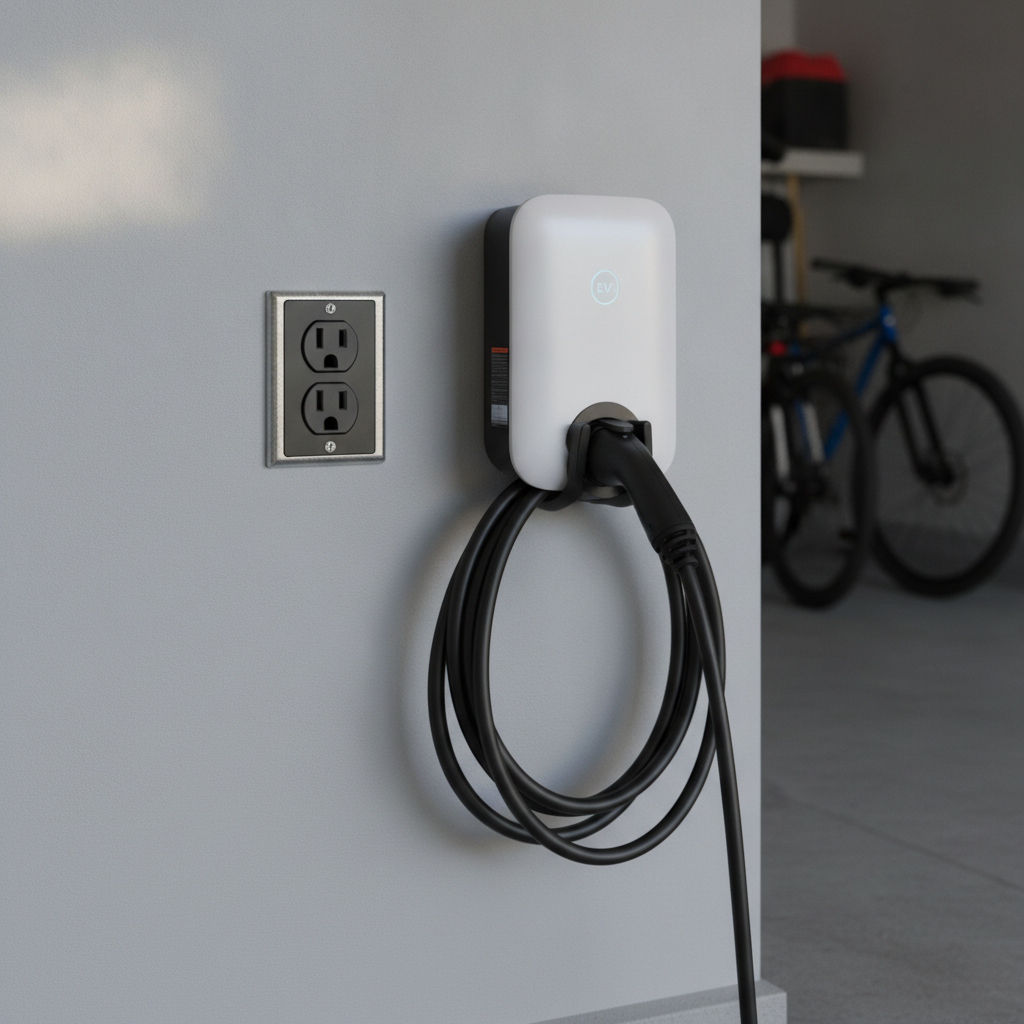
If you are installing a receptacle for charging, you want an industrial-grade, spec-grade NEMA 14-50 with high-quality contacts, not a builder-grade outlet. A quality unit like the Hubbell industrial-grade NEMA 14-50 receptacle costs several times what the cheap one does, and that price difference is exactly the point. It is rated for the heat a car charger generates over hours, where the cheap one slowly cooks itself.
Disclosure: As an Amazon Associate we earn from qualifying purchases. That does not change what we recommend or why.
So Should You Use an Outlet at All, or Hardwire?
For many installs, hardwiring the charger directly is the better call. Receptacles top out at 50 amps, so any charger above that has to be hardwired anyway. Hardwiring also removes the receptacle as a failure point entirely, and in many jurisdictions it sidesteps the GFCI-breaker requirement because the protection is built into the EV equipment. A plug-in setup keeps flexibility if you move or swap chargers. If you want the full breakdown of that tradeoff and the receptacle-specific details, our guide on using a 240V outlet for EV charging goes deeper.
A good Level 2 charger sits at the center of either approach. If you are shopping, a hardwire-capable 48-amp unit gives you the most headroom, and you can compare current options among Level 2 EV chargers on Amazon. Match the charger’s amperage to the circuit your electrician installs, not the other way around.
The Bottom Line
The reason an EV-ready outlet costs more than the receptacle behind your stove is not markup. It is a dedicated circuit, correctly sized wire, a GFCI breaker, an industrial-grade receptacle or a hardwired connection, and an install that respects the continuous-load rule. Your range outlet skips every one of those because a stove never asked it to. For a real sense of the full install price and what drives it, see our EV charger installation cost guide.
Charging an EV is one of the best things about owning one. Doing it off the wrong outlet is one of the few ways to turn that convenience into a hazard. Spend the money on the circuit, not on a repair after the outlet melts.
Sponsored
Need Help With Your EV Charger?
Get expert guidance on installation, costs, and the right charger for your home.
Get Your Free EstimateNeed Help With Your EV Charger?
Get expert advice on the right charger, installation requirements, costs, and how to maximize your savings.