 Installation
Table of Contents
NEMA 14-50 Outlet vs Hardwired EV Charger: The Real Tradeoffs
When you’re getting a Level 2 charger installed, the electrician will ask one question that catches most people off guard: “You want me to put in a NEMA 14-50 outlet, or should I hardwire it?”
It sounds like a small detail. It isn’t. The choice affects your charging speed, your cost, your code compliance, and how easy it’ll be to swap chargers down the line. Here’s how to actually decide.
What Each Option Means
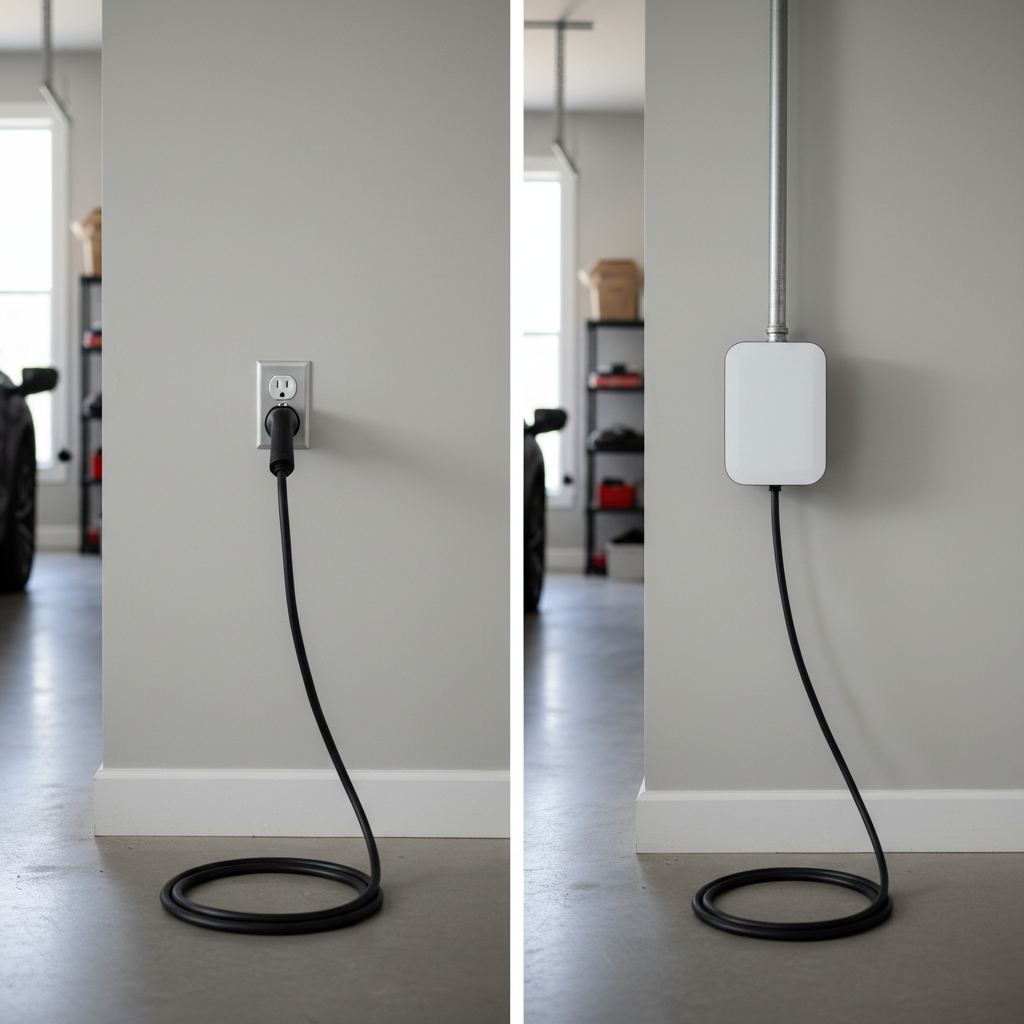
NEMA 14-50 outlet: A standard 240V receptacle (the same kind RVs and welders use) installed on the wall. Your EV charger plugs into it like an appliance. You can unplug the charger, take it on a trip, or replace it without rewiring anything.
Hardwired: The charger is permanently wired into the electrical system - no plug, no outlet. To remove or replace it, an electrician has to disconnect the wires.
Both are fed by the same 240V circuit from your panel. The difference is in how the charger connects to that circuit.
Cost Difference: Smaller Than You Think
Hardwired installs are usually $50–$150 cheaper than 14-50 outlet installs because you skip the cost of the receptacle, the GFCI breaker (more on that), and a heavier-duty box. But that’s not the whole story.
If you’re buying a charger that comes with a NEMA 14-50 plug already attached, you’re paying for the plug whether you use it or not. Hardwiring sometimes means cutting that plug off, which voids the warranty on some units. Always check.
The GFCI Breaker Issue (This Is the Big One)
Since the 2020 NEC, any 14-50 outlet for an EV charger has to be protected by a GFCI breaker. EV chargers themselves have ground-fault detection built in. So you end up with two GFCI devices in series.
This causes a lot of nuisance tripping - the breaker thinks it sees a leakage current from the charger’s internal GFCI and trips for no reason. We’ve seen homes where the breaker trips once a week with a 14-50 install and never trips with the same charger hardwired.
Hardwired chargers don’t need the GFCI breaker because the charger itself satisfies the protection requirement. If you’re choosing based on reliability alone, hardwired wins for this reason.
Charging Speed: A 25% Difference at the Top End
Most EV chargers are sold in two flavors: a 40-amp version that ships with a NEMA 14-50 plug, and a 48-amp version that’s hardwired-only.
That difference matters more than it sounds. NEC requires 14-50 outlets to be derated to 80% continuous load - so a 50-amp circuit with a 14-50 outlet maxes out at 40 amps continuous, or about 9.6 kW. A hardwired 48-amp install on a 60-amp circuit gives you the full 11.5 kW.
For most homeowners, 9.6 kW (about 30 miles of range per hour) is plenty. But if you’re charging a long-range truck (F-150 Lightning, Rivian, Cybertruck) and want to top up overnight, the 25% speed bump from hardwiring matters.
Portability and Future-Proofing
This is where 14-50 wins. With an outlet, you can:
- Take the charger with you on long trips (most ship with travel adapters)
- Swap chargers without an electrician - Tesla today, ChargePoint tomorrow
- Sell the charger separately if you move
- Use the outlet for an RV, welder, or other 240V tool
If you rent, plan to move within a few years, or just like the optionality, the 14-50 outlet earns its keep.
Hardwired installs lock you into one charger. Replacing it later is a service call.
When to Pick Each
Pick NEMA 14-50 if:
- You want flexibility to swap chargers
- You’re under 40 amps anyway (most cars charge at 32–40 amps)
- You travel and want a portable charger
- You might use the outlet for non-EV purposes later
Pick hardwired if:
- You’re installing a 48-amp or 80-amp charger (Tesla Wall Connector, Tesla Universal, ChargePoint Home Flex at high amperage)
- You’ve had nuisance GFCI trips in the past
- The charger sits outside in weather (hardwired is cleaner for outdoor installs)
- You want the cheapest, lowest-maintenance install
The Bottom Line
If you’re a typical homeowner with a single EV charging at 32–40 amps, the NEMA 14-50 is almost always the better call. The flexibility is worth more than the small cost or speed difference.
If you’re charging a long-range truck or want to commit to a single high-amperage charger long-term, hardwire it. The faster charging and the elimination of GFCI nuisance trips are real benefits.
Either way, what matters is that the circuit is sized correctly for the charger and the wire run. Get the install done by a licensed electrician who’s done EV chargers before - they’ll spot the gotchas (panel capacity, run length, wire gauge) that DIY installs almost always miss.
Sponsored
Need Help With Your EV Charger?
Get expert guidance on installation, costs, and the right charger for your home.
Get Your Free EstimateNeed Help With Your EV Charger?
Get expert advice on the right charger, installation requirements, costs, and how to maximize your savings.