 Basics
Table of Contents
One of the first questions new EV owners ask - and one of the biggest anxieties for people considering an EV - is how long it takes to charge at home. The answer depends on a few variables: what kind of charger you have, how big your car’s battery is, and how depleted the battery is when you plug in. Once you understand these variables, the math is straightforward.
The short version: with a proper home charging setup, most people wake up to a full battery every morning without ever thinking about it.
The Two Types of Home Charging
Level 1: Standard Household Outlet (120V)
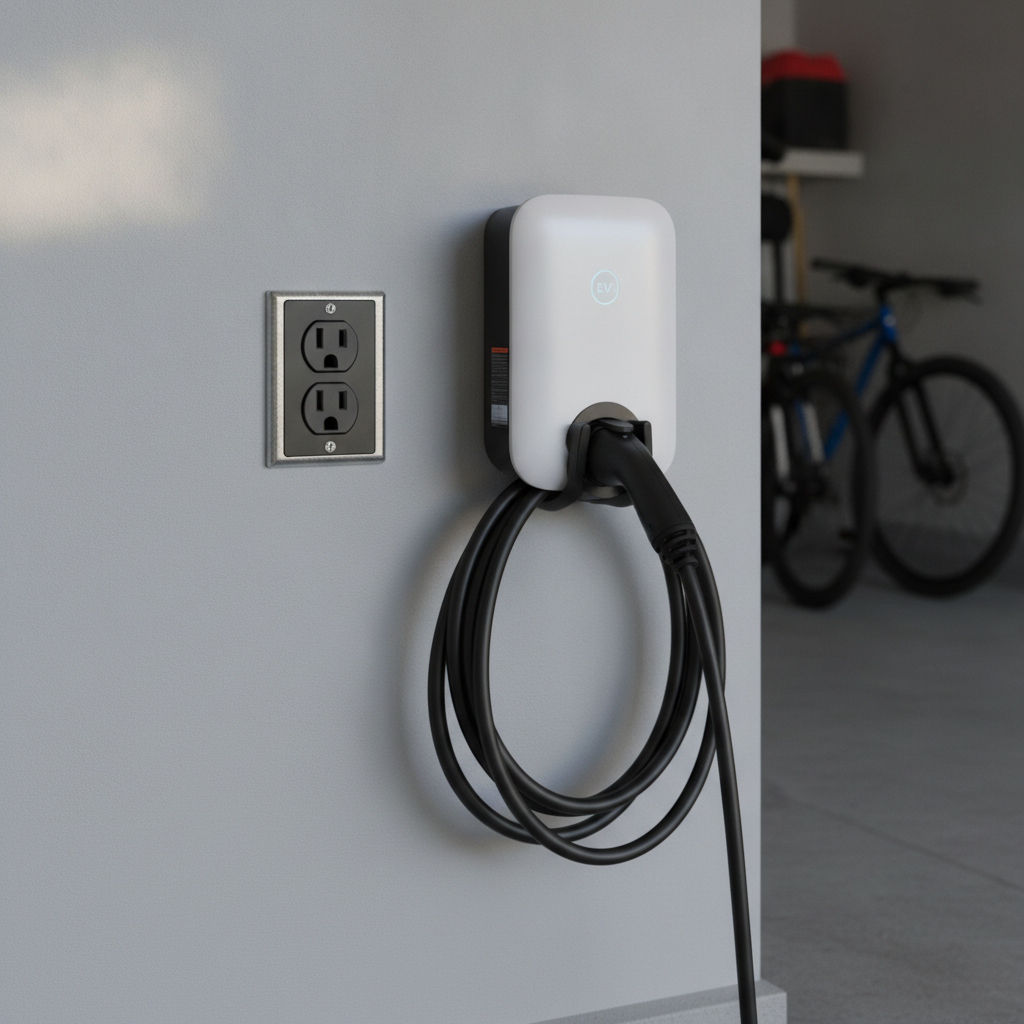
Every EV comes with a portable cord that plugs into a standard 120-volt outlet - the same kind you use for lamps and phone chargers. This is called Level 1 charging.
Level 1 delivers roughly 3–5 miles of range per hour of charging. That’s slow. Very slow.
If you drive 30 miles per day, Level 1 charging takes 6–10 hours to replace that range. If you drive 50 miles, you’re looking at 10–17 hours. For many drivers this works fine - you plug in at night and unplug in the morning. But if you have a long daily commute, or if you ever deplete your battery significantly, Level 1 may not be able to keep up.
Level 1 requires no installation. You plug the included cord into any grounded 120V outlet. It’s the fallback option, not the ideal long-term solution.
Level 2: Dedicated 240V Circuit
Level 2 charging uses a 240-volt circuit - the same voltage as a clothes dryer or electric oven. This is what a professionally installed home EV charger delivers.
Level 2 adds 15–44 miles of range per hour, depending on your charger’s amperage and your vehicle’s onboard charger capacity. This is 4–10x faster than Level 1.
With Level 2, most EV owners can fully charge overnight regardless of how depleted the battery was. A nearly dead 75 kWh battery (like a standard Model 3) typically charges fully in 8–10 hours on Level 2.
What Determines Charging Speed?
Three factors determine how fast your EV charges at home:
1. Charger Amperage (EVSE Output)
Home chargers (called EVSEs - Electric Vehicle Supply Equipment) vary in amperage. Common ratings:
- 16 amps - basic Level 2, adds about 12 miles/hour
- 32 amps - mid-range, adds about 25 miles/hour
- 40 amps - good all-around, adds about 30 miles/hour
- 48 amps - maximum for home use, adds up to 44 miles/hour
Higher amperage chargers cost more and require a larger circuit breaker, but they also offer the most flexibility as battery sizes continue to grow.
2. Your Vehicle’s Onboard Charger
The charger in your wall doesn’t directly charge your battery. It supplies power to your car’s onboard charger (OBC), which converts AC power to DC and manages battery charging. Your OBC has a maximum acceptance rate - if your car’s OBC tops out at 32 amps, a 48-amp wall charger won’t charge it any faster. It just means the wall charger has headroom.
Most modern EVs accept 32–48 amps. Some older or lower-cost EVs may only accept 16 or 24 amps. Check your owner’s manual or the vehicle’s spec sheet.
3. Battery Size (kWh)
A larger battery takes longer to charge from empty to full. Simple as that. A 40 kWh Chevy Bolt fills faster than a 100 kWh Tesla Model S, all else being equal.
Real-World Charging Times: Popular EVs
Here’s how long typical home charging takes for common vehicles, assuming Level 2 at 32 amps (a common mid-range setup):
| Vehicle | Battery Size | Miles Added/Hour | Empty to Full |
|---|---|---|---|
| Tesla Model 3 (Standard) | 57.5 kWh | ~25 miles | ~8–9 hours |
| Tesla Model 3 (Long Range) | 82 kWh | ~30 miles | ~10–11 hours |
| Tesla Model Y (Long Range) | 82 kWh | ~30 miles | ~10–11 hours |
| Ford F-150 Lightning (Standard) | 98 kWh | ~25 miles | ~12–13 hours |
| Chevy Equinox EV | 85 kWh | ~25 miles | ~11 hours |
| Rivian R1T | 135 kWh | ~25 miles | ~17 hours |
| Hyundai Ioniq 6 | 77.4 kWh | ~30 miles | ~10 hours |
Note: These are approximate. Actual times vary based on ambient temperature, battery temperature, and how the vehicle manages charging speed at high states of charge (most EVs slow down in the last 20% of charging).
The Overnight Charging Reality
Here’s how most EV owners actually think about charging: they don’t.
You come home, plug in, and go to bed. You wake up to a full battery. The actual number of hours it took doesn’t matter because you were asleep. This is fundamentally different from stopping at a gas station - charging happens while you’re doing other things.
The only time charging speed matters:
- You drive more miles per day than your Level 2 charger can replace overnight
- You need to charge quickly before a trip
- You’ve run the battery very low and need it charged within a few hours
For the vast majority of daily driving, any properly installed Level 2 charger handles the job comfortably.
How Much Does It Cost to Charge at Home?
Electricity costs vary by location, but the national average is around $0.17 per kWh. At that rate:
- Charging a 75 kWh battery from empty costs about $12.75
- Monthly cost for driving 1,000 miles: approximately $40–$60 depending on your vehicle’s efficiency
Compare that to gasoline: the same 1,000 miles in a 30 MPG car at $3.50/gallon costs about $117. Home EV charging is dramatically cheaper than gas.
Time-of-use electricity rates can make charging even cheaper. Many utilities offer lower rates overnight (often midnight to 6 AM). Setting your charger to charge during those windows can reduce your electricity cost by 30–50%, depending on your utility.
When Is Level 1 Enough?
Level 1 charging is sufficient if:
- You drive fewer than 30 miles per day consistently
- You have access to charging at work or other locations during the day
- You have a plugin hybrid (PHEV) with a smaller battery
- You’re using EV charging as a backup to public charging
If any of those apply, the included cord may work fine. But for most households with one EV as a primary vehicle, a Level 2 charger installation is worth the investment.
Should You Install a 40-Amp or 48-Amp Charger?
If you’re already running a new circuit for a Level 2 charger, going to 48 amps over 40 amps is a minor cost difference at installation time. The wire gauge and breaker size step up, but not dramatically. Future-proofing matters here: larger-battery EVs are becoming more common, and having the capacity to charge faster is worth the small upfront difference.
A 48-amp charger requires a 60-amp breaker (NEC requires breakers to be sized at 125% of continuous load). If your panel has the capacity, this is typically the recommendation.
Frequently Asked Questions
Does charging slow down when the battery is almost full? Yes. Most EVs taper their charging speed in the final 10–20% of charge to protect battery longevity. If your charger app shows slower speeds as you approach 100%, that’s normal and intentional.
Should I charge to 100% every night? Most EV manufacturers recommend keeping the battery between 20% and 80% for daily use to extend battery life. Charging to 100% is fine occasionally (before a long trip), but most owners set their charge limit to 80–90% for everyday charging.
How cold weather affects charging time at home? Cold batteries charge more slowly, especially below freezing. Some EVs preheat the battery when plugged in before charging begins. In very cold climates, expect charging to take 20–30% longer in winter. Keeping the car plugged in even when not actively charging allows the battery management system to maintain optimal temperature.
Can I charge two EVs with one home charger? Not simultaneously on the same charger. You’d need two separate circuits and two chargers. Some newer smart chargers support dual-vehicle charging by alternating power, but they’re not common. If you’re planning for two EVs, run two circuits during installation - it’s cheaper to do both at once.
Does the charger run all night even when the battery is full? No. The charger and the vehicle both have safety systems that stop power delivery when charging is complete. You won’t waste electricity, and you can safely leave the car plugged in overnight.
What’s the difference between kW and kWh? Kilowatts (kW) measure power - the rate of energy flow. Kilowatt-hours (kWh) measure energy - the total amount stored. A 7.2 kW charger running for 10 hours delivers 72 kWh of energy. Battery capacity is measured in kWh. Charging speed is measured in kW.
Does fast charging at public stations damage the battery? High-speed DC fast charging (Level 3) does cause slightly more battery degradation over time compared to Level 2 charging. Home Level 2 charging is gentle on the battery and is actually the preferred charging method for daily use.
Sponsored
Need Help With Your EV Charger?
Get expert guidance on installation, costs, and the right charger for your home.
Get Your Free EstimateNeed Help With Your EV Charger?
Get expert advice on the right charger, installation requirements, costs, and how to maximize your savings.