 Installation
Table of Contents
Somewhere between “just add a breaker” and “you need a whole new panel” sits the subpanel. It’s the option a lot of electricians mention almost as an afterthought, and it’s the one homeowners understand the least. So let’s clear it up: most people installing a single Level 2 charger don’t actually need a subpanel. But there’s a real set of situations where it’s the smartest money you’ll spend, and a few where it’s the only thing that makes the install possible at all.
Here’s how to figure out which camp you’re in before anyone quotes you.
What a Subpanel Actually Does
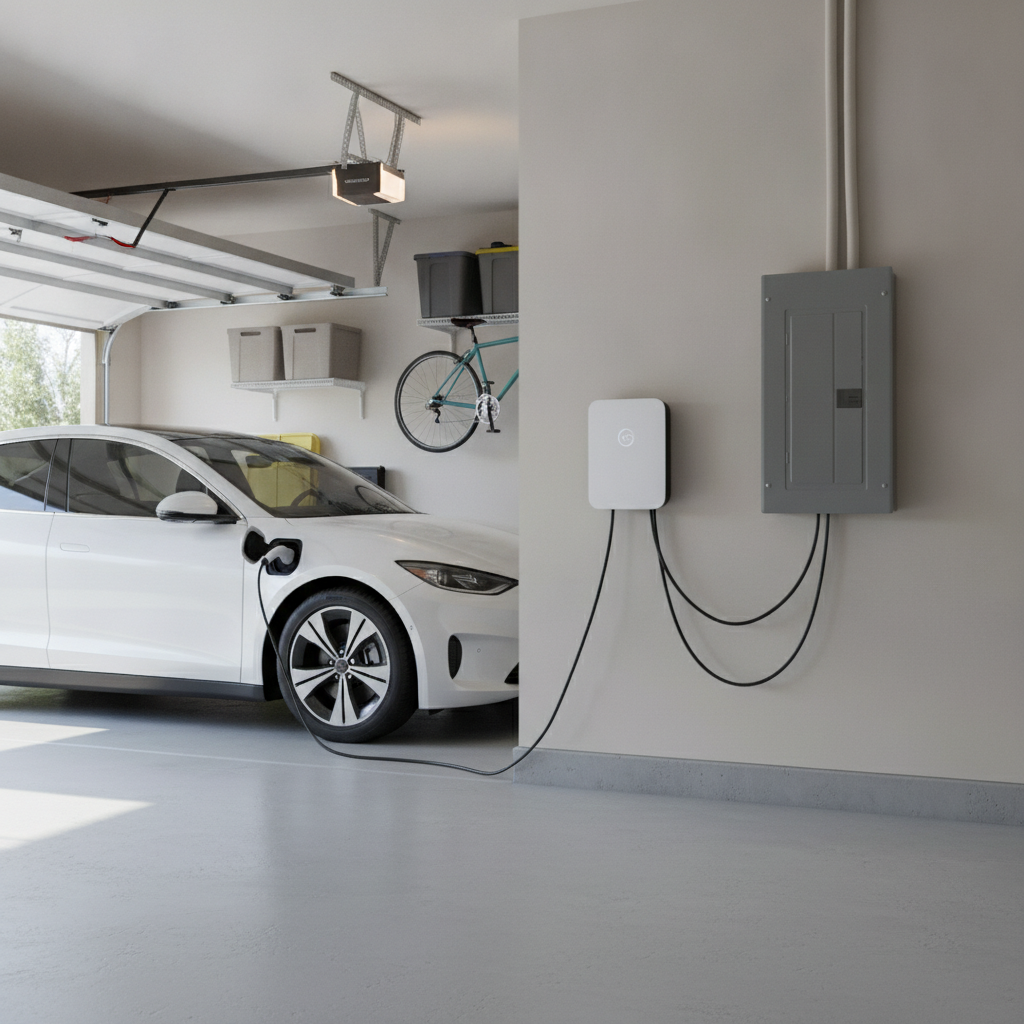
A subpanel is a smaller breaker box fed from your main panel by a single dedicated circuit. Think of it as a branch office. You run one fat feeder from the main panel (say, 60 or 100 amps), land it in the subpanel, and then split that capacity into multiple breakers out in the garage or wherever your charger lives.
The thing it does not do is create electricity out of nowhere. A subpanel fed by a 60-amp breaker still only draws up to 60 amps from your main service. If your main panel is genuinely maxed out on total capacity, a subpanel won’t save you. It just relocates and organizes capacity you already have.
That distinction is the whole ballgame, so keep it in mind as we go.
The Number That Decides Everything: Available Capacity
Before you can answer the subpanel question, you have to answer the capacity question. And that comes down to a load calculation.
The two methods electricians use both live in the NEC. The simpler one is the standard calculation (Article 220 Part III), and the one most relevant to existing homes adding a single load is NEC 220.83, the “existing dwelling” method. The 220.83 approach lets the electrician take your home’s actual demand into account rather than assuming every appliance runs at once. It generally adds up your existing loads at a demand factor (often 100% for the first 8 kVA and 40% for the rest), then adds your new EV charger load on top, and checks whether the total fits inside your service rating.
The other rule you cannot escape is the 80% continuous-load rule. An EV charger is a continuous load (running three or more hours), so its circuit has to be sized to 125% of the charger’s draw. Flip that around and it means a breaker can only carry 80% of its rating continuously. The real numbers:
- A 32A charger needs a 40A breaker and 8 AWG copper.
- A 40A charger needs a 50A breaker (this is your typical NEMA 14-50 setup) and 8 AWG copper.
- A 48A charger needs a 60A breaker and 6 AWG copper.
So when someone says “I have a 48-amp charger,” what your panel actually has to absorb is a 60-amp circuit’s worth of allocated capacity.
How to Read Your Own Panel’s Headroom
You can get a rough read in about ten minutes, and it’ll tell you whether to even bother worrying about a subpanel.
- Find your main breaker rating. Top of the panel, big switch. It’ll say 100, 150, or 200. That’s your service size.
- Add up the big consumers. Electric range (40-50A), electric dryer (30A), electric water heater (30A), central AC (20-40A), heat pump, hot tub, pool pump. These are the loads that eat your headroom. A gas-everything house has tons of room. An all-electric house often doesn’t.
- Count open slots. A charger needs two adjacent slots for a double-pole breaker. No slots free is a separate problem from no capacity free, and the fix is different.
The honest version: on a 200A service with gas heat and gas water heating, adding a 60A circuit for a 48A charger is usually no sweat. On a 100A service that already feeds an electric range, electric dryer, and central air, a 220.83 calc can come back over the limit fast, and that’s when the conversation gets interesting.
So When Does a Subpanel Actually Make Sense?
A subpanel solves a specific set of problems, and it’s worth being precise about which ones.
You’re out of breaker slots, but not out of capacity. This is the classic case. Your 200A panel has plenty of headroom on paper, but every physical slot is full and tandem breakers aren’t allowed or aren’t enough. Instead of swapping the whole panel, your electrician runs one feeder to a subpanel and gives you six or eight fresh slots. Cheaper and faster than a full upgrade.
The charger is far from the main panel. If your panel is in a finished basement and the charger goes on the far side of a detached garage, running one feeder to a local subpanel can be cleaner and cheaper than pulling a long, heavy individual circuit. You also gain slots out there for future stuff: a second charger, shop tools, lighting.
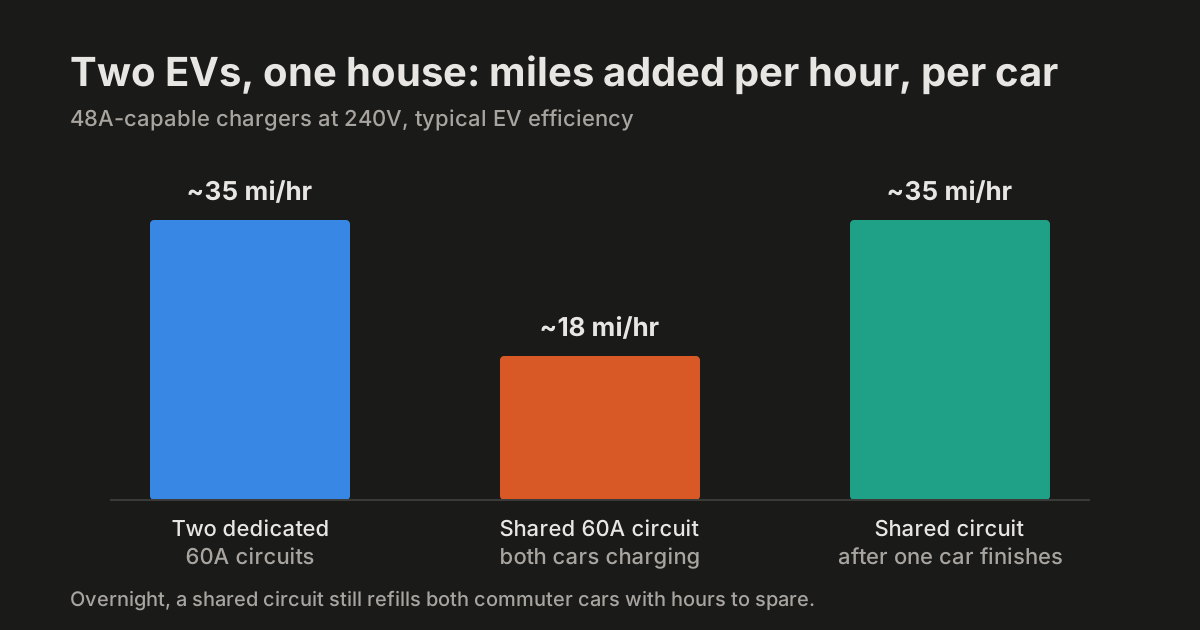
You’re planning a second EV. If two cars are coming, a subpanel with a load-management setup or two charger circuits is the forward-looking move. You build the branch office once.
Detached structures. A detached garage or workshop frequently needs its own subpanel anyway for code and practicality reasons. Adding the charger circuit there is natural.
Where a subpanel does not help: when your main service genuinely lacks capacity. If the 220.83 calc says your 100A service is already near its ceiling, a subpanel just moves the bottleneck. You need either a panel and service upgrade or a load-management device that throttles the charger when the house demand spikes.
Subpanel vs. Panel Upgrade: The Cost Picture
This is usually what the decision comes down to, so here are realistic 2026 ranges. Regional labor swings these a lot, and California, New York, and the Pacific Northwest run high.
| Solution | Typical 2026 Cost |
|---|---|
| Single charger circuit off main panel | $400 - $1,200 |
| Adding a subpanel (60-100A feeder, short run) | $400 - $1,000 |
| Full panel upgrade (100A to 200A) | $1,800 - $3,500 |
| Service entrance upgrade (utility coordination) | $1,000 - $3,000+ |
The math is usually this simple: if you have capacity but no slots, the subpanel at $400 to $1,000 beats a $1,800-plus panel swap every time. If you don’t have capacity, the subpanel is wasted money and the upgrade is the real fix. A load-management device (smart panel, or an EV energy management system) can sometimes bridge the gap for less than either, by capping the charger when the rest of the house is drawing hard.
Your Self-Check Decision Framework
Run yourself through this:
- 200A service, gas heat/water, slots open? No subpanel. Just run the circuit.
- Plenty of capacity but no open slots? Subpanel. It’s the cheap win.
- Charger going somewhere far or a second EV coming? Subpanel, sized generously.
- 100A service, all-electric house, calc near the limit? Not a subpanel problem. You’re looking at a panel/service upgrade or load management.
- Old Federal Pacific, Zinsco, or 60A panel? Replace it regardless. Don’t hang a charger off a panel with known safety issues.
One more thing worth checking before you spend anything: EV charger tax credits and rebates for 2026. Several utility programs now subsidize panel work as part of electrification incentives, and that can flip the cost math entirely.
The Step You Can’t Skip
You can do the napkin math from this post and walk into your quotes a lot smarter than the average homeowner. But the napkin math isn’t the permit-ready answer. A licensed electrician running a proper NEC 220.83 load calculation on your actual loads is the only thing that tells you, with a real number, whether you’ve got the headroom. Ask for that calc explicitly when you get quotes, and ask the electrician to show you the math: existing demand, new charger load, and how close the total lands to your service rating. The good ones will walk you through it. The number it spits out is what decides subpanel, upgrade, or neither, and it’s worth getting before you commit a dollar.
Sponsored
Need Help With Your EV Charger?
Get expert guidance on installation, costs, and the right charger for your home.
Get Your Free EstimateNeed Help With Your EV Charger?
Get expert advice on the right charger, installation requirements, costs, and how to maximize your savings.