 Installation
Table of Contents
The second EV sneaks up on people. The first one arrives with research and ceremony and a shiny new wall charger. Then two years later the other car in the driveway goes electric too, and suddenly there is a nightly negotiation over one charging cable. If that is your household, you have three real options, and the right one depends almost entirely on what your electrical panel has left to give.
Here is how we walk people through it, with real numbers current as of August 2026.
First, the Question That Decides Everything: What Can Your Panel Spare?
A typical modern home has 200-amp service; plenty of older homes are still on 100 or 150. A single 48-amp charger requires a 60-amp breaker, and a second one requires another 60. That is 120 amps of breaker capacity dedicated to cars on a panel that also runs your HVAC, range, dryer, and water heater.
Whether that fits is not a guess, it is a calculation. An electrician runs a load calculation under NEC Article 220, adds up your existing demand, and tells you how many amps of headroom exist. Everything below flows from that number. (We covered the panel side in detail in do you need a panel upgrade for an EV charger, and the answer for a second charger is “more often than for the first one.”)
Three outcomes:
- Plenty of headroom: run a second dedicated circuit, done.
- Some headroom, not 60 amps of it: load sharing is your friend, and it is a very good friend.
- No headroom: load sharing still works, or you are into a panel upgrade or a load management device.
Option 1: Two Dedicated Circuits
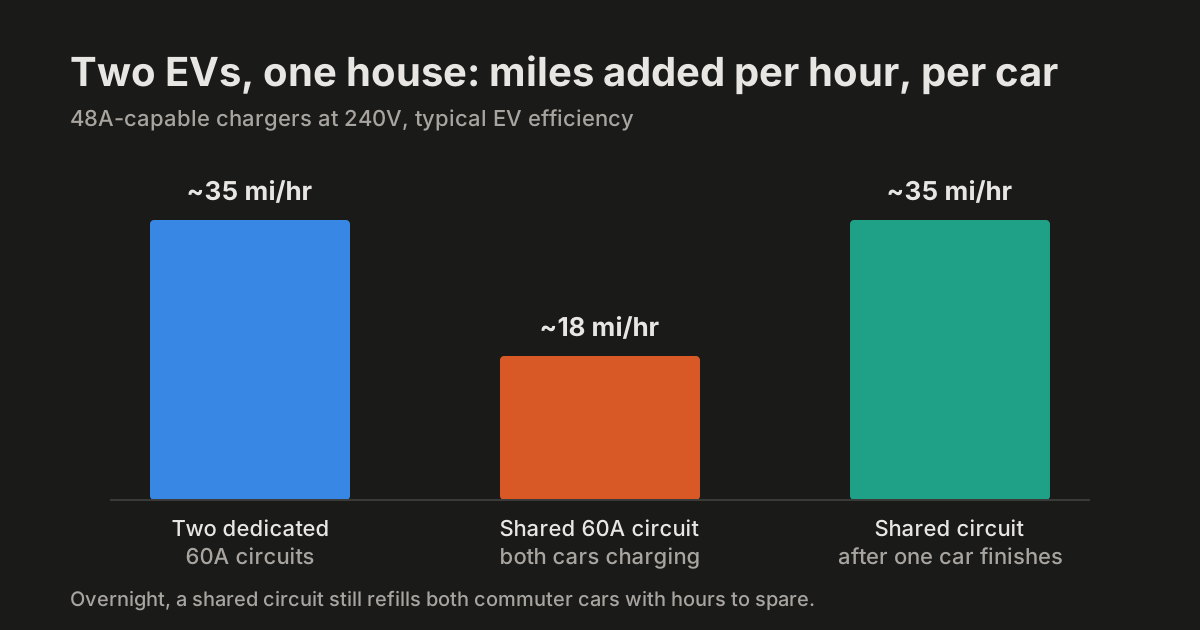
The straightforward path. A second 60-amp circuit and a second 48-amp charger, both cars charge at full speed simultaneously, roughly 11.5 kW each. A 48-amp charger adds around 30 to 45 miles of range per hour depending on the vehicle, so two commuter cars both refill completely overnight with hours to spare.
Cost, as of mid-2026: the second charger itself runs $400 to $700 for the well-reviewed names (see our Level 2 buyer’s guide for specifics), and the circuit install typically lands between $600 and $1,800 depending on the run length from panel to parking spot. Long conduit runs to a detached garage cost more.
The honest question is whether you need it. Two cars each driving 40 miles a day need about 25 kWh of charging combined per night. Even one shared 48-amp charger delivers that in a bit over two hours. Full speed for both cars is lovely; it is also usually overkill.
Option 2: Load Sharing (What We Recommend for Most Two-EV Homes)
Load sharing, also called power sharing, lets two chargers live on one circuit. The chargers talk to each other and split the available amperage so the pair never exceeds the circuit’s limit. Two 48-amp-capable units on a single 60-amp circuit will each deliver 24 amps when both cars are plugged in, and the moment one car finishes, the other unit automatically ramps back up to the full 48.
Most of the major charger lines now do this natively: Tesla Wall Connectors share up to 48 amps across units, and several other smart chargers (Emporia and Wallbox among them) pair the same way over a local connection. You buy two matching units, your electrician lands them on one circuit, and the sharing is a settings-screen exercise.
The math on a shared 60-amp circuit: each car gets roughly 5.75 kW when both are drawing, which is about 15 to 22 miles of range per hour, per car. Across a 10-hour overnight window that is 150+ miles into each vehicle, every night. Unless someone in the house drives like a regional courier, you will never notice the difference. And if your panel is tighter than 60 amps, the same trick works on a 50 or 40-amp circuit at proportionally lower speeds; slower shared charging that actually fits your panel beats a paper-spec charger that does not.
Cost: two share-capable chargers at $450 to $650 each, plus one circuit install if you do not already have one. If your existing charger already supports sharing, the incremental cost of EV number two can be as low as one more unit and an afternoon of labor: call it $700 to $1,100 all-in.
Option 3: The Panel Upgrade (Sometimes Right, Usually Last Resort)
If the load calculation says no and you want full-speed simultaneous charging anyway, a 100-to-200-amp service upgrade typically runs $2,500 to $5,000 depending on your utility, meter location, and whether the service entrance cable needs replacing. It is real money, but if your panel is a crowded 100-amp relic anyway, the EVs are sometimes just the excuse the house needed.
A middle path worth knowing about: load management devices (sometimes called smart splitters or dynamic load controllers) watch your whole-home draw and throttle the EV circuit when the house is busy. They run $300 to $600 plus install and can squeeze a legitimate charging setup into a panel that a static load calculation would fail. Code treats these well under NEC 625.42’s energy management provisions; a good installer will know when one fits.
What We Would Do
For most two-EV households: one 60-amp circuit, two load-sharing chargers. It is the cheapest path that removes the nightly cable fight, it sails through panel limits that would block a second dedicated circuit, and the real-world charging difference versus two full-speed circuits rounds to zero for commuter driving. Spend the savings on off-peak charging rates, where the actual money is.
And whichever path you take, get the load calculation done first. Every expensive two-EV mistake we hear about started with someone buying hardware before anyone looked at the panel.
Sponsored
Need Help With Your EV Charger?
Get expert guidance on installation, costs, and the right charger for your home.
Get Your Free EstimateNeed Help With Your EV Charger?
Get expert advice on the right charger, installation requirements, costs, and how to maximize your savings.