 Basics
Table of Contents
The pitch sounds like science fiction sold at a car dealership: your EV isn’t just a car, it’s a giant battery on wheels that can run your house during an outage and maybe even sell power back to the grid. The surprising part is that in 2026, the pitch is mostly true - with a list of asterisks long enough that plenty of buyers who paid for “bidirectional capable” hardware still can’t actually use it. Here’s the honest state of things.
The Vocabulary, Quickly
Three terms get blurred together constantly, and they’re very different products:
- V2L (vehicle-to-load): Your EV has outlets. You plug things into the car - power tools, a fridge during an outage, a campsite. Nearly every modern EV offers some version of this (typically 1.8 - 9.6 kW), and it requires zero home equipment. If someone says their car “can power the house” and they mean an extension cord to the refrigerator, this is V2L.
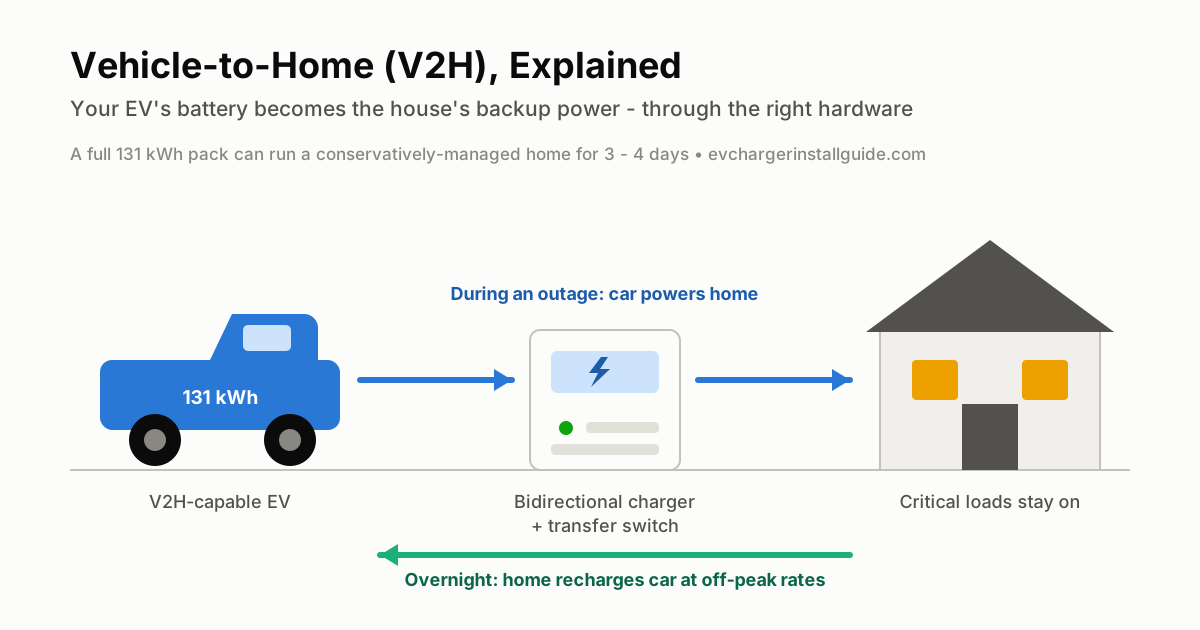
- V2H (vehicle-to-home): The car back-feeds your actual electrical panel through a bidirectional charger and a transfer switch, running some or all of your home’s circuits during an outage. This is the one most homeowners actually want, and the one with real hardware requirements.
- V2G (vehicle-to-grid): The car exports to the utility grid, potentially earning you money in demand-response programs. Technically live in a handful of utility pilot programs as of mid-2026, but not something a typical homeowner can enroll in yet in most of the country.
What Actually Works in 2026
The proven, buy-it-today V2H combination remains the Ford F-150 Lightning with Ford’s Home Integration System - the setup Ford and Sunrun have been installing since 2022. An extended-range Lightning carries a 131 kWh battery; the average US home draws roughly 30 kWh a day, so a full truck can plausibly carry a conservatively-managed house for three or four days. That’s more stored energy than nine Tesla Powerwall 3s.
Beyond Ford, the picture filled in meaningfully over the last two years: GM’s Energy home system brought V2H to the Silverado EV and its Ultium siblings, Tesla enabled bidirectional support starting with the Cybertruck ecosystem, and several manufacturers (Hyundai, Kia, Nissan among them) have V2H-capable hardware in various stages of rollout with partnered home equipment. The key phrase in every case is with partnered home equipment - which brings us to the asterisks.
The Asterisks That Kill Most Installations
The car and the charger must be a certified pair. Bidirectional operation isn’t a generic standard you can mix and match yet, despite ongoing progress on ISO 15118 and the CCS/NACS transition we covered in our June 2026 charging standards roundup. A “bidirectional capable” EV plugged into a normal Level 2 charger does nothing in reverse. The charger, the inverter, and the vehicle firmware all have to agree.
You need islanding equipment, not just a charger. Back-feeding your panel during an outage without disconnecting from the grid is both illegal and dangerous to line workers. Every legitimate V2H install includes a transfer switch or microgrid interconnect device that isolates your home first - the same requirement as any generator or battery system.
Whole-home vs. partial-home matters. Some systems back up your entire panel; others back up a critical-loads subpanel (fridge, furnace blower, some lights and outlets). The critical-loads approach is significantly cheaper and honestly what most families need. Nobody needs their central air running from a truck battery.
What It Costs, Realistically
As of mid-2026, a complete V2H installation - bidirectional charger/inverter, transfer equipment, permits, and labor - typically lands between $5,000 and $12,000 on top of the vehicle, depending on the system and how much of your home you’re backing up. Compare that honestly against two alternatives: a standby generator ($4,000 - $8,000 installed, plus fuel and maintenance forever) or a dedicated home battery (a Powerwall 3 installation typically runs $12,000 - $16,000 for 13.5 kWh).
The V2H math wins specifically when you were already buying the truck. You’re effectively adding a 100+ kWh battery to your house for the cost of the interconnection hardware alone - per kilowatt-hour, nothing else is close. The math loses if you’re buying the vehicle for backup power, or if your household regularly needs the car and the backup at the same time. Your battery drives away every morning; a Powerwall doesn’t.
One cost note that surprises people: the electrical prep work is ordinary. The vehicle side of a V2H system typically lands on a 60 - 80 amp circuit, similar territory to a high-end conventional install - our EV charger installation cost guide covers that baseline work, and it’s a useful sanity check on any V2H quote’s wiring line items. If your panel needed an upgrade for a normal Level 2 charger, it needs one for this too.
Three Questions Everyone Asks
“Does back-feeding my house wear out the car’s battery?” Less than people fear. Home backup duty is a gentle discharge compared to driving - powering a conservatively-managed house draws 1 - 3 kW continuously versus the 100+ kW spikes of highway acceleration. Manufacturers running V2H programs warranty the use case, and the cycling math on a 100+ kWh pack doing occasional outage duty adds up to a small fraction of the degradation driving causes. The battery-killer myth mostly dates from early V2G studies assuming daily deep-cycling for grid arbitrage, which is a different (and still debated) duty cycle.
“Can I go off-grid with it?” No - and any salesperson implying it is overselling. V2H systems are outage backup, not primary power. The car has to leave and charge somewhere.
“What happens when the truck’s at 20%?” The management systems let you set a reserve floor - typically you configure backup to stop discharging at whatever state of charge you need to reach a DC fast charger. Your house goes dark before your car gets stranded, which is the right failure order.
Our Take: Who Should Actually Do This in 2026
Do it if: you’re already buying a V2H-capable vehicle, your area sees real outages (PECO customers in storm-prone corridors know who they are), and you’d otherwise be shopping for a generator or home battery anyway. The incremental cost beats every alternative on stored energy per dollar, and the fuel is whatever your overnight rate is - pair it with off-peak charging and your backup power costs pennies per kWh.
Wait if: you’d be switching vehicles or stretching the budget specifically for this, or you’re hoping V2G income will pay for it. The V2G revenue story is real in pilot programs and still mostly theoretical for regular homeowners; treat any projected earnings in a sales pitch as marketing until your specific utility offers an enrollable program with published rates.
Either way: get the interconnection quote before the vehicle purchase, not after. The homeowners who end up frustrated are almost always the ones who bought “bidirectional capable” on the window sticker and assumed the house side would be plug-and-play. In 2026, the house side is the whole project.
Sponsored
Need Help With Your EV Charger?
Get expert guidance on installation, costs, and the right charger for your home.
Get Your Free EstimateNeed Help With Your EV Charger?
Get expert advice on the right charger, installation requirements, costs, and how to maximize your savings.